Submit a request

Off-Grid Solar Power Plants

Complete independence from the grid — an off-grid solar power supply system for locations completely lacking infrastructure.
Off-Grid Solar Power Plants

The Sun Generates, Batteries Store

An off-grid solar power plant is a closed-loop power supply system based on heterojunction (HJT) panels, an inverter, a charge controller, and a battery bank. It operates without a connection to the power grid: it generates electricity during the day and delivers it from the storage system at night. Unigreen Energy designs turnkey off-grid solar power plants (SPPs): from calculating the daily load balance to commissioning and servicing. Capacity ranges from a few kW to industrial facilities of dozens of MW. It is economically viable wherever diesel is expensive and the grid is unstable or completely absent.
The Sun Generates, Batteries Store

Why an
Off-Grid SPP Instead of
Diesel or the Grid?

Operates fully isolated

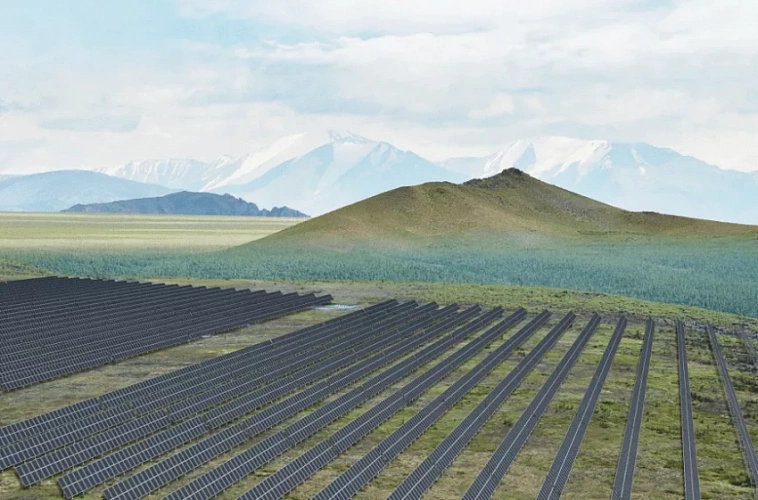
An off-grid solar power plant is essential in field conditions — taiga, steppe, mountains, etc.

A day without sun is not an emergency

The battery bank maintains the load for 1–3 days of backup.

Multi-fold cost reduction

Replacing diesel generation with solar yields an immediate economic effect: the cost per kWh from an off-grid SPP is 3 to 7 times lower than from a diesel generator at fuel prices in remote areas.

Scalable

You can add panels and expand the battery bank without shutting down the facility.

Heterojunction technology (HJT) works in freezing temperatures

Our modules provide 8-12% more output in the cold than standard monocrystalline ones.

Integration with any backup source

Diesel, gas, wind, external grid — the control system prioritizes solar energy and turns on the backup only when necessary.

Know This: The Sun Works for You Even Where There Is No Grid

We will calculate the off-grid power supply configuration for your facility: load, geography, and required autonomy. Leave a request — we will send you a techno-economic justification
Request a free project estimate

Which Power Plant to Choose?

Off-Grid

Off-Grid

They operate completely independently of the external grid: solar panels, inverters, and energy storage systems (ESS) provide the facility with electricity without connecting to the power system. They are suitable for remote sites where grid infrastructure is unavailable or its deployment is economically unviable.

For regions with variable insolation and high fuel delivery costs, the SPP integrates with diesel or gas generation (Autonomous Hybrid Power Systems — AHPS), thereby reducing fuel consumption by 30-40%. For temporary facilities, a mobile containerized solution (Mobile AHPS) is provided, which can be deployed in a few days and easily relocated to a new site.
Hybrid

Hybrid

They combine the advantages of grid-tied and off-grid systems. They can operate both in parallel with the grid and isolated from it. The control system automatically switches between modes depending on the availability of grid voltage, battery charge, and current load, ensuring an uninterrupted power supply in any situation.
Grid-Tied (On-Grid)

Grid-Tied (On-Grid)

They are connected directly to the existing power system and operate in conjunction with it, replacing purchased electricity with their own "solar" generation during daytime hours. An energy storage system (ESS) is not required — the grid instantly compensates for any missing capacity.
Station Connection Options

For Whom Do We Build Off-Grid SPPs?

Unigreen Energy implements projects in Russia and worldwide. Head office — Moscow.
Oil & Gas and Mining
Agriculture
Telecommunications
Construction
Transport Infrastructure
Municipal Facilities

700 MW

total capacity under the company's management.

100+ projects

full cycle, any complexity, Moscow and other cities.

In-house heterojunction production

the largest in Europe. We control the quality of panels for every off-grid facility.

Didn't find your industry?

Contact us, and we will prepare a project tailored to your needs.
Submit a request

How We Build a Turnkey Off-Grid SPP

1. Questionnaire — we gather the load profile, geography, and autonomy requirements.
2. Energy Audit — we calculate the daily and seasonal balance, as well as insolation at the facility's location.
3. TEJ (Techno-Economic Justification) — output forecast, fuel cost replacement, payback periods, and a 3D model.
4. Contract — we fix the technical specifications, equipment configuration, and deadlines.
5. Design & Engineering — diagrams, panel layout, and specifications for batteries, inverters, and monitoring systems.
6. Supply — photovoltaic panels from our own factory, along with certified inverter and battery equipment.
7. Installation — supporting structures, solar modules, cable routes, and the switchboard room.
8. Commissioning — testing all modes: generation, battery charging/discharging, switching to backup, and emergency protection.
9. Personnel Training — routine maintenance, diagnostics, and working with the monitoring system.
10. 2-year warranty + optional servicing for the entire lifespan.
Similar products
Solar module 144 cells M10 MBB
  • Linear performance guarantee 30
  • Warranty for the module 15
  • Rated power 540-560 WT
  • Efficiency 25.7%
  • Operating temperature –40 до +85°C
  • Configuration ‘glass-glass’ technology
  • Dimensions, mm 1135×2256×35
Solar module 144 cells M6 MBB
  • Linear performance guarantee 30
  • Warranty for the module 15
  • Rated power 440-455 WT
  • Efficiency 24.6%
  • Operating temperature –40 до +85°C
  • Configuration ‘glass-glass’ technology
  • Dimensions, mm 1051×2134×35
Solar module 66 cells M2+
  • Linear performance guarantee 30
  • Warranty for the module 15
  • Rated power 355-370 WT
  • Efficiency 23.5%
  • Operating temperature –40 до +85°C
  • Configuration ‘glass-glass’ technology
  • Dimensions, mm 1852×997×35
Frequently Asked Questions
In which industries do off-grid solar power plants pay off the fastest?

Where diesel fuel is expensive: remote industrial sites, shift camps, agribusiness, and telecom hubs without a stable grid. Replacing diesel provides a return on investment within 3-6 years.

What makes up the cost of an off-grid solar power plant?

Four components: panels and structures, energy storage systems, inverter & controller equipment, installation, and commissioning. The battery bank is the most expensive part, but also one of the most critical: its capacity is determined by the required autonomy. An accurate calculation is only possible after analyzing the loads.

How effective is an off-grid solar power plant in northern regions?

Heterojunction panels perform better than standard modules at low temperatures and in diffused light. For regions with low winter solar insolation, we design the system based on the worst-performing month and integrate a gas or diesel backup if necessary.

How much can diesel fuel costs realistically be reduced?

In regions with medium to high insolation — by 70-90% in the summer period, and 40-60% on an annual basis.

Is an off-grid solar power plant suitable for construction sites?

Yes. Containerized mobile hybrid systems are designed specifically for this purpose: they can be transported by standard freight, deployed within a few days, and relocated to the next project site.

Can a custom project be tailored to specific business requirements?

That is exactly how we work, as there are no cookie-cutter solutions for industrial facilities. Every Unigreen Energy off-grid system is engineered for a specific load profile, climate, and budget.

Other solutions

Utility-scale SPPs
Utility-scale SPPs

Provide your business with green energy with energy-efficient grid-connected solar installations that produce electricity steadily even in cloudy weather and help to fix electricity costs, protecting against rising tariffs and unpredictable price spikes
Explore
Hybrid Solar Power Plants

Hybrid Solar Power Plants

Energy independence without compromise — during grid outages, high tariffs, or in the absence of power lines.
Explore